When Mistakes Become Treasure
Factory errors and misprints are among the rarest and most fascinating Pokémon cards in existence. Here's how to identify, value, and collect them.
Types of Pokémon Card Errors
Pokémon card errors fall into several categories, each with different rarity and value implications. Printing errors include ink smears, color shifts (where the entire card is printed with incorrect hue registration), and missing ink layers — the most famous being 'Shadowless' Base Set, which was later revealed to be an early print run error rather than an intentional design change. Cutting errors produce off-center cards, miscuts that show adjacent cards, and in extreme cases, cards cut from the wrong sheet (resulting in a card with one side's front and another side's back). Assembly errors create dual-fronted cards (two card fronts laminated together with no back), wrong-back cards (a Pokémon front with an Energy card back), and blank-backed cards. Text errors are less common but include typo cards like the Base Set '1st Edition' error where the stamp was misaligned, and prerelease cards where text was later corrected. Each type of error has its own collector community, with cutting errors and assembly errors generally commanding the highest premiums due to their visual uniqueness and extreme rarity.
Most Famous and Valuable Pokémon Card Errors
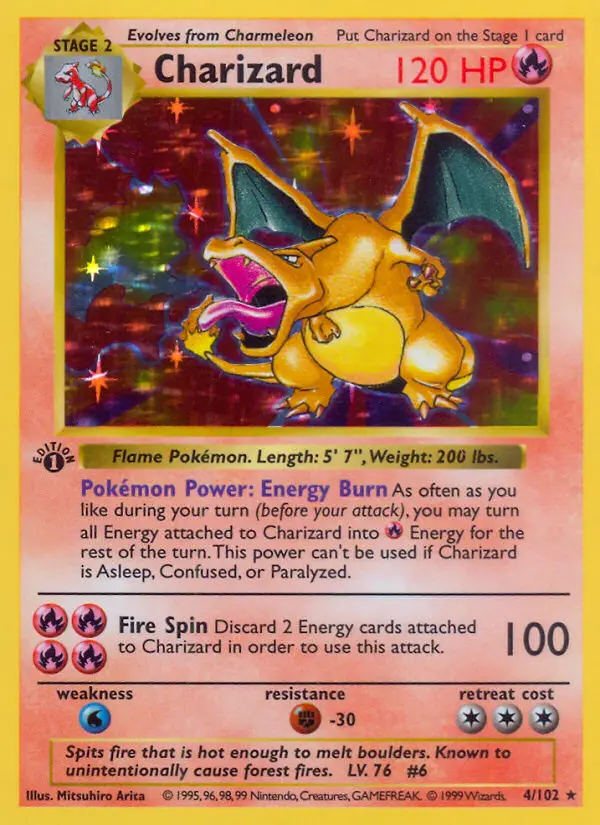
The Base Set Shadowless run is the most famous error in Pokémon TCG history — it resulted from an early print run where the drop shadow beneath the illustration box was omitted, and collectors now pay significant premiums for Shadowless holos in good condition. The Jungle Weepingbell error card, which used the wrong illustration, is one of the most sought-after text/print errors. prerelease Clefable with a 'prerelease' stamp originally intended only for promotional purposes is another iconic error — some early prerelease stamps were accidentally left on retail copies. The Skyridge 'reverse holo error' where some cards show an incorrect holofoil pattern is prized by error collectors. Modern error collecting has gained traction too: miscut Scarlet & Violet cards showing adjacent card artwork, and the occasional ink-misregistration error where holographic foil bleeds outside the intended pattern, are actively traded on error-specific marketplaces and Discord communities. Perhaps the most dramatic errors are wrong-back cards and dual-front cards, which can sell for $1,000–$10,000+ depending on the card and the nature of the error.
How to Identify and Authenticate Error Cards
Not every off-center card is an error — centering variations of 60/40 or even 70/30 are common within normal printing tolerances and don't qualify as true 'error' cards. A genuine cutting error typically shows extreme misalignment (90/10 or worse) or reveals part of an adjacent card on the same sheet. Authentication starts with comparing the card against known examples of the same error type — check error-specific databases, community wikis, and collector forums for reference images. Then examine the card stock, holofoil pattern, font, and set symbol to confirm it's a genuine factory product and not a custom-made counterfeit. Error cards should look 'wrong' in exactly one specific way while everything else matches a normal production card. If multiple elements seem off, it's more likely a counterfeit than a genuine error. Professional grading companies like PSA and CGC will grade certain types of error cards (miscuts, wrong backs, ink errors) with an 'error' designation on the label, which dramatically increases the card's liquidity and value. For any error card worth more than $100, professional grading is strongly recommended.
Common questions
01 Are Pokémon card errors worth more than normal cards?
Yes, genuine error cards are typically worth significantly more than their normal counterparts — often 2–10x depending on the error type and severity. Wrong-back cards and dual-front cards can be worth 50–100x the normal card's value. However, minor centering issues (less than 70/30) are not considered errors and don't carry a premium.
02 How rare are Pokémon card errors?
True factory errors are extremely rare — only a handful of miscut, wrong-back, or assembly error cards escape quality control per millions of printed sheets. Printing errors (ink shifts, missing layers) are slightly more common but still represent well under 1% of total print runs. This rarity is what drives the high collector demand.
03 Can modern Pokémon cards have errors?
Yes. While modern print quality is generally better than vintage, errors still occur. Miscuts, ink registration errors, and holofoil pattern errors have been documented in Sword & Shield and Scarlet & Violet sets. Modern errors are often caught quickly, making early-print errors particularly valuable.
04 Should I grade an error card?
If the error card is genuine and worth more than $100, grading is almost always worthwhile. PSA and CGC will note the error on the slab label, which authenticates the error, prevents disputes about whether it's a genuine factory mistake, and significantly increases the card's resale value and liquidity.
Related Collecting Guides

Track Your Collection
Get Pokex free. Identify any Pokémon card and see what it is worth in seconds.
No credit card. No signup. Just scan.
Scan to download
Point your phone camera at a code

